domingo, 25 de julho de 2010

A Turquia no Chipre vs. Israel em Gaza

Turkey in Cyprus vs. Israel in Gaza


Em face às recentes críticas de Ancara sobre o que chama de "prisão a céu aberto" de Israel em Gaza, realizadas na data de hoje, que marca o aniversário da invasão de Chipre pela Turquia, sua relevância é fora do comum.

EmineErdoganA política turca frente a Israel, historicamente cordial e que apenas há uma década estava próxima a uma aliança total, esfriou desde que os islamistas tomaram o poder em Ancara em 2002. Sua hostilidade se tornou explícita em janeiro de 2009, durante a guerra Israel-Hamas. O Primeiro Ministro Recep Tayyip Erdoğan pomposamente condenou a política israelense como "perpetração de ações desumanas que levará a autodestruição" e até invocou Deus ("Alá irá... punir aqueles que transgridem os direitos dos inocentes"). Sua esposa Emine Erdoğan hiperbolicamente condenou as ações israelenses como sendo tão terríveis que "sequer podiam ser expressas em palavras".

Suas agressões verbais auguraram hostilidades adicionais que incluíram insultar o presidente de Israel, ajudar a patrocinar a "Flotilha da Liberdade" e chamar de volta o embaixador turco.

Essa fúria turca provoca uma pergunta: Israel em Gaza é realmente pior do que a Turquia em Chipre? Uma comparação mostra sua alta improbabilidade. Veja alguns contrastes:

* - A invasão turca de julho-agosto de 1974 envolveu o uso de napalm e "espalhou terror" entre os aldeões gregos cipriotas, de acordo com o Minority Rights Group International. Contrastando, a "batalha feroz" de Israel para tomar Gaza contou somente com armas convencionais e resultou virtualmente sem vítimas civis.

* - A ocupação subsequente de 37 porcento da ilha equipara-se a "limpeza étnica forçada" segundo William Mallinson em uma monografia que acaba de ser publicada pela Universidade de Minnesota. Contrastando, se alguém deseja acusar as autoridades israelenses de limpeza étnica em Gaza, ela foi contra seu próprio povo, os judeus, em 2005.

* - O governo turco tem patrocinado o que Mallinson chama de "política sistemática de colonização" em terras anteriormente gregas no norte de Chipre. Os turcos cipriotas totalizavam cerca de 120.000 em 1973; desde então, mais de 160.000 cidadãos da República da Turquia foram assentados em suas terras. Nem uma única comunidade israelense permanece em Gaza.

* - Ancara governa a zona ocupada com tanta rigidez que, nas palavras de Bülent Akarcalı, político veterano turco, "O Norte de Chipre é governado como se fosse uma província da Turquia". Um inimigo de Israel, o Hamas, governa em Gaza.

* - Os turcos montaram uma estrutura que faz de conta ser autônoma chamada de "A República Turca do Norte de Chipre". Os habitantes de Gaza desfrutam de uma verdadeira autonomia.

* - Um muro que atravessa a ilha mantém os pacíficos gregos fora do norte de Chipre. O muro de Israel exclui terroristas palestinos.

DivisaoChipredesde74

E ainda temos a cidade fantasma de Famagusta, onde as ações turcas correspondem às da Síria sob os criminosos Assads. Após a força aérea turca ter bombardeado a cidade portuária cipriota, as forças turcas entraram para se apossarem dela, com isso impelindo toda a população grega (temendo um massacre) a fugir. As tropas turcas isolaram a área central da cidade, chamada Varosha e a ninguém é permitido morar lá.

Varosha-ChipreConforme esse centro grego em ruínas é invadido pela natureza, ele se torna uma bizarra cápsula do tempo de 1974. Steven Plaut da Universidade de Haifa visitou-a e relata: "Nada mudou. ... Diz-se que as agências de automóveis no centro fantasma, até os dias de hoje estão estocadas com modelos antigos de 1974. Por anos após o estupro de Famagusta, a população contava que ainda via lâmpadas acesas nas janelas dos edifícios abandonados".

Curiosamente, outra cidade fantasma levantina também data do verão de 1974. Exatamente 24 dias antes da invasão de Chipre pelos turcos, tropas israelenses evacuaram a cidade fronteiriça de Quneitra, entregando-a às autoridades Sírias. Hafez al-Assad optou, também por motivos políticos, não permitir que ninguém morasse lá. Décadas mais tarde, ela também permanece vazia, refém da beligerância.

Erdoğan alega que as tropas turcas não estão ocupando o norte de Chipre, e sim, estão lá na "Capacidade turca como potência garantidora", seja lá o que isso queira dizer. O mundo, no entanto, não é trapaceado. Se Elvis Costello cancelou recentemente um concerto em Tel-Aviv em protesto pelo "sofrimento dos inocentes [palestinos]," Jennifer Lopez cancelou um concerto no norte de Chipre em protesto à "violação dos direitos humanos".

Em suma, o Norte de Chipre compartilha características com a Síria que lembram uma "prisão a céu aberto" mais do que Gaza. Interessante que uma Ancara hipócrita se coloque no alto do pedestal dando lição de moral sobre Gaza mesmo que ela própria aja de forma bem mais agressiva na área que governa. Em vez de se intrometer em Gaza, os líderes turcos deviam acabar com a ocupação ilegal e destruidora que por décadas divide Chipre de forma trágica.

quinta-feira, 22 de julho de 2010

Supreme Muslim Council Declared Temple Mount to be Jewish

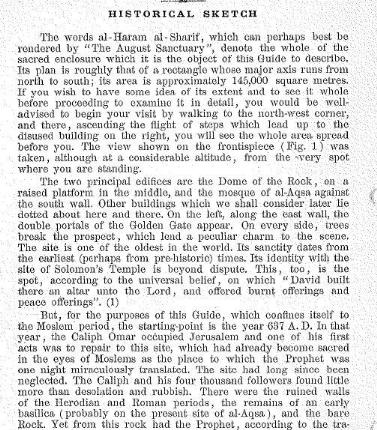
You can download the entire 16 page PDF version of the 1925 Guidebook by clicking HERE.

Supreme Moslem Council: Temple Mount is Jewish

by Hillel Fendel

(IsraelNN.com) The widely-disseminated Arab Moslem position that the Temple Mount is not Jewish has been debunked – by the Supreme Moslem Council (Waqf) of Jerusalem, in a Temple Mount guide published in 1925.

Guidebook Puts the Lie to Current Arab Campaign

In 1997, the chief Moslem cleric of the Palestinian Authority, Mufti Ikrama Sabri, stated, “The claim of the Jews to the right over [Jerusalem] is false, and we recognize nothing but an entirely Islamic Jerusalem under Islamic supervision…”

Thus began a campaign to convince the world that the millennia-old natural association between Jerusalem and Jews was untrue. As Islamic Movement chief Raed Salah stated in 2006, “We remind, for the 1,000th time, that the entire Al-Aqsa mosque [on the Temple Mount], including all of its area and alleys above the ground and under it, is exclusive and absolute Moslem property, and no one else has any rights to even one grain of earth in it.”

However, it is now known that this “absolute” Moslem claim is actually not as absolute as claimed. In fact, back in 1925, the Supreme Moslem Council – also known as the Waqf, which has overseen Temple Mount activities on behalf of the Moslem religion for hundreds of years – boasted proudly that the site was none other than that of Solomon’s Temple.

The Jerusalem-based Temple Institute (http://www.templeinstitute.org) reports that it has acquired a copy of the official 1925 Supreme Moslem Council Guide Book to Al-Haram Al-Sharif (the Moslem name for the Temple Mount). On page 4, the Waqf states, “Its identity with the site of Solomon’s Temple is beyond dispute. This, too, is the spot, according to universal belief, on which ‘David built there an altar unto the L-rd…’, citing the source in 2 Samuel XXIV,25.

In addition, on page 16, the pamphlet makes reference to the underground area in the south-east corner of the Mount, which is refers to as Solomon’s Stables. “Little is known for certain of the history of the chamber itself,” the guide reads. “It dates probably as far back as the construction of Solomon’s Temple. According to Josephus, it was in existence and was used as a place of refuge by the Jews at the time of the conquest of Jerusalem by Titus in the year 70 A.D.”

The Temple Mount in Jerusalem was in fact the site of the two Jewish Holy Temples which stood for nearly 1,000 years (see below).

Proof of Moslem Anti-Jewish Revisionism

The Temple Institute’s Rabbi Chaim Richman writes that the pamphlet provides proof that the Waqf’s current position is a departure from traditional Muslim belief. “In recent years,” he writes, “the Moslem Waqf has come to deny the historic existence of the Holy Temple, claiming that the Temple Mount belongs solely to the Moslem nation, and that there exists no connection between the Jewish nation and the Temple Mount. It is clear from this pamphlet that the revised Waqf position strays from traditional Moslem acknowledgment of the Mount’s Jewish antecedents.”

“The current denial of historical reality is merely one tool in the war being waged by Moslems against the G-d of Israel and the entire ‘infidel’ world,” Richman declares.

Examples of the new Palestinian/Arab position on Jerusalem:

PA Mufti Sabri was quoted in the Palestinian daily Al-Ayyam on November 22, 1997 as saying, “The ‘Al-Buraq’ Wall [the Western Wall] is a part of the Al-Aqsa Mosque. The Jews have no relation to it.”

The same newspaper, on July 18, 1997, reported that Hamad Yusef, head of The Institution for the Rejuvenation of the Palestinian Heritage, referred to the “false historical claim of the Jews in the holy city, a claim which they were unable to prove in all of the excavations conducted by foreign groups for the past hundred years.” The paper also stated that Hamad “accused the Israelis of unprecedented historical forgeries, emphasizing the Palestinian, the Arab and the Islamic nature of the holy city for the past 6,000 years. Israel fails in her attempt to find a historical connection to Jerusalem.” (courtesy of Jewish Virtual Library)

Jewish History on the Mount

The Temple Mount in Jerusalem was the site of the two Jewish Holy Temples, the first of which was built by King Solomon in the year 832 BCE, close to 1,500 years before Islam was founded. It stood for over 400 years, and after the 70-year Babylonian Exile, a Second Temple was built on the same site. Thus, for nearly 1,000 years, Holy Temples stood on the site, until the Romans conquered the entire land and destroyed the Second Temple. Though the area came under the control of the Romans, Byzantines, Moslems, Christians, Turks, British and others over the intervening centuries, Jerusalem and the Temple Mount were always the focus of Jewish religious and national yearnings, and continued to be the Jews’ “capital” even while in exile. In the Six Day War of 1967, the modern State of Israel liberated the Temple Mount area and all of Jerusalem, placing it under Jewish control once again after a hiatus of 1,900 years.

Israel, however, never actualized its sovereignty over the holy Temple Mount site, but rather granted the Waqf nearly total control. Jews, in fact, have not been allowed to pray there ever since then-Chief IDF Rabbi Shlomo Goren led a prayer service there on the first Tisha B’Av after the liberation. Jews’ visiting hours are also restricted.

terça-feira, 20 de julho de 2010

The Forgotten Refugees IV - 2nd Class Citizens in Israel

"We have here a people whose primitiveness sets a record" wrote a Ha'aretz reporter, not of the palestinians, but of Mizrahi (Oriental Jews) refugees. Similar statements were made by ashkenazic politicians (and Prime Ministers) such as David Ben Gurion, Golda Meir and Levi Eshkol.

This anti-Mizrahi prejudice among the Ashkenazi elite (European Jews) translated into them being whisked away to live in the remotest parts of Israel and populate what are known as "development towns" that failed to develop into anything beyond a receptacle for broken promises and shattered dreams.

The Ashkenazi elite also set about "civilising" the Mizrahi Jews and shaping them into modern "Israelis". Of course, to a certain extent, this happened to all immigrants, but since the Ashkenazi were calling the shots, it was their culture that most influenced the Israeli ideal.

Today, mizrahim still make up the bulk of Israel's poor and undereducated; they are often stereotyped in the media as pimps and hustlers; their culture is seen as somewhat inferior; and their accent, although it is the more accurate form of Hebrew, is scorned.

Don't call me "black"

אל תקרא לי שחור

Prejudice against oriental Jews in Israel today (in Hebrew)

Links (This is how it works here):

The european secular Zionists - They pretend this never happened; try to sugarcoat their ugly past or say that this doesn't happen in Israel anymore -- A lie.

The european anti-Zionist leftists - They pretend that life under Muslim rule was better and that Mizrahi Jews were happier as second class citizens under brutal anti-semitic dictatorships like Lybia or Syria than as second class citizens in Israel.

Post-Zionism and the Sephardi question

What were Arab-Jewish relations really like?

Israel's other Arabs

"Why Jews left Arab Lands" a Progressive Sephardic view

"The Mizrahi ("Arab?") Jews: The Forgotten Refugees

sábado, 17 de julho de 2010

The 10th anniversary of Ehud Barak's betrayal of Israel and the people of south Lebanon


Written by Charbel Barakat
Sunday, 23 May 2010


Today, is the 10th anniversary of Israel’s withdrawal from what used to be known as the “security zone.” On May 23, 2000 – on the instructions of then Israeli Prime Minister Ehud Barak – all Israeli units operating north of the border inside Lebanese territory were pulled back inside Israeli territory.

According to Barak it was in implementation of United Nations Security Council Resolution 425 issued in 1978 after an Israeli incursion into Lebanon (in response to PLO attacks across the border).

So, 23 years after it had entered the country to fight its enemies, Israel’s government decided to pull its troops back from Lebanon abruptly. Barak at the time said he was complying with UN resolutions and that he believed Lebanon was no longer a threat. That was the Israeli version of the Labor Government then.

But as IDF forces were pulling back, Iranian-backed Hezbollah militias were entering every single village and town evacuated by the Israelis. According to Hassan Nasrallah, the commander of Hezbollah, Israel withdrew because of the strikes by the so-called “resistance,” which in fact was the Iranian-backed militia. The Hezbollah story is that southern Lebanon was occupied by the Israelis, who had a proxy militia known as South Lebanon Army. And that Hezbollah struggled to liberate the land from its “Zionist occupiers.”

But there is a third version rejecting the first two and claiming it represents the struggle of the people of southern Lebanon who struggled against terror and were removed from their ancestral lands because of Barak’s policies on the one hand and the abandonment of western Lebanon last resisting free people against the hordes of Hezbollah and their Iranian and Syrian backers on the other hand.

Unfortunately, the third story has no tellers these days. Barak has Israel’s media at his service, so he can boast about his betrayal of southern Lebanon and his own Israeli people; and Nasrallah has his Iranian-funded media to claim his victories against the population that resisted him in southern Lebanon.

On this 10th anniversary of the betrayal of the people of south Lebanon, the truth is going to be blanched. It will take time for the witnesses of that drama to share the facts with the world, but it will happen no matter what.

The people within the so-called “security zone” are Lebanese citizens who have suffered at the hands of Palestinian terrorist groups since the 1970s and at the hands of Hezbollah since the 1980s. They are the sons and daughters of the land for centuries. The PLO then and the Iranian Revolutionary Guards today are foreign occupation forces. Israel entered Lebanon twice, first in 1978 and again in 1982, to strike back against terror forces shelling its territory from inside Lebanon.

The Lebanese citizens living in the border towns wanted the Lebanese Army only, neither the Israelis and certainly not the terrorist forces. But Lebanon’s government collapsed in 1975, and by 1990 it was controlled by Syria. The people of the south had no choice but to accept aid and support from Israel’s occupation forces. To be clear between the terrorists and barbarians who were slaughtering civilians and aiming at establishing a Jihadi regime and the forces of the state of Israel, an ally to the United States and at Peace with Egypt and Jordan, the choice was made against Hezbollah and the Syrian-Iranian axis.

The South Lebanon Army, under control of Israel, was by far better than ending up in the detention camps of the Iranian Pasdaran or in the torture facilities of Hezbollah and Syria. Hence, a large segment of the population of south Lebanon, Christian, Druse, Shia and Sunnis adhered to the SLA and stood by Israel’s forces as a common front against the terrorists. Israel’s successive governments stood in solidarity with the people of south Lebanon. A brotherhood between the IDF and the SLA was the cornerstone of the common defense against Hezbollah and Syria.

South Lebanon’s civil society would have preferred to be under the direct protection of the UNIFIL, a UN force dispatched to protect the Peace and the local population as of 1978. But UNIFIL’s bureaucrats refused to take the southern Lebanese under their auspices leaving them to strive for themselves. The SLA and the local population did the right thing by defending themselves and they did so under international law which grants them the right to fight for survival, hoping that when the Israelis wanted to leave, they would allow them to defend themselves and seek UN protection.

In 2000, then Israeli Prime Minister and Labor Party leader Ehud Barak betrayed an Israeli tradition of solidarity with the SLA and an Israeli natural friendship with the southern Lebanese. He not only ordered the abrupt withdrawal of IDF from the security zone but also a dismantlement of the SLA.

All that the southern Lebanese people wanted – as villagers living on their ancestral lands – was to defend it until they were free or die trying. Barak took away their most sacred right, the right to resist. He ordered his forces to shut off the borders as south Lebanon’s border populations were disarmed and about to be overwhelmed by the Jihadi barbarians. We know that a majority of the Israeli people were frustrated by that move, and we know that many in the IDF resented Barak’s stab in the back of the only population in the Middle East that actually stood by the Jewish people of Israel.

The southern Lebanese were forced to march during the night in a dishonorable exodus into Israel. In one night, Barak and his political allies in the government and abroad killed the last free enclave in Lebanon. In one night, he invited Hezbollah to the international borders. In on night, he terminated the only fighting force that was shedding blood shoulder-to-shoulder with the IDF in defending that part of the Middle East against the Jihadi terrorists. He took out the only friendship that could have told the world that Israel itself should not be betrayed or abandoned because it had not betrayed its own allies. Unfortunately, Barak’s reckless stab in the back of Israel’s only allies in the Middle East opened the path for the Jihadist forces to surround Israel further from the north and from the south. A few months later, the Aqsa intifada was shattering the myth of invincibility in Israel and from then on Israel was alone in a region filled with hatred. Barak took away the southern Lebanese people’s own ability to testify that Israel was doing good in the region, it was protecting its small and weak neighbors in southern Lebanon.

Today when Israel’s image is assaulted by the lethal propaganda machine of the Iranian petrodollars worldwide and in the United States, and when anti-semitism is running high in Western capitals, the only underdogs who would have told the world that Israel had been defending Christians, Druse, Shia and Sunni in that free enclave of Lebanon; those underdogs uprooted from their homes and lands because of the arrogance of a few politicians who thought they had it figured out, cannot testify to save the honor of their former allies. Blame Barak and his elitist friends in Israel and the United States for that.

This had to be said and it will be repeated as long as needed until some courageous leaders in Israel and the United States will apologize to the population of southern Lebanon for what has been done to them. History is unique in the ways it sends its messages. Three months after abandoning the people of south Lebanon, Israel was hit by a Jihadi war that has not stopped since, neither across the Lebanese border nor across the frontier of Gaza. And one year after that, America was hit by the beast of terror on 9/11. Offering the small villages of southern Lebanon to the Jihadists didn’t appease them. Just the opposite, it emboldened them. We hope the free world learned the lesson.

However, we do know that the majority of Israelis do not believe in Barak’s pragmatic miscalculations and they do want a friendship with their neighbors from the north. Naturally, it would have been better to have the SLA fending off the Iranian assault waves than having the enemy roaming the borders. Now they have to deal with Hassan Nasrallah’s 40,000 missiles to the north, Assad’s chemical forces, Hamas terror from the south and Ahmedinijad’s forthcoming nukes. Had Israel not dismantled the southern Lebanese resistance against terror, Hezbollah would have been dealing with a strong indigenous force to reckon with. Let’s see if Israel’s basic instincts correct the mistakes of its own leaders.

Meanwhile, we the people of southern Lebanon haven’t lost hope. We continue to struggle politically around the world for the liberation of Lebanon. We are now part of a vast Diaspora that stands firmly with the United States and the international community including Europe, Russia and the Arab moderates, in a campaign to defeat the terror forces. Our commitment to freeing Lebanon persists from generation to generation. We are still committed not only to peace with Israel but also to a friendship with the Jewish people in the Holy Land. Despite the betrayal by some of its politicians, Israel has a full right to exist in the region and all nations have right to freedom and democracy. We hope that the democratic forces among Arabs and other nations of the Middle East would soon rise against dictatorship and fascism and we will return to our occupied land and live in Peace.

May 23, 2000 was a hard benchmark in our history, but it is certainly not the end of it. We will return and we will live all in peace.

– Col. Charbel Barakat, Lebanese Army (Ret.) is an historian and a former civil society leader in south Lebanon. He is now a counterterrorism expert in Canada.

sexta-feira, 16 de julho de 2010

PFLP Leader: 'Arafat Died of AIDS'


Here’s Ahmad Jibril, Secretary-General of the PFLP General Command, on Hizballah’s Al-Manar TV, publicly admitting the truth about Yasser Arafat’s death for the first time. (Courtesy of MEMRI TV.)

Ahmad Jibril: When Abu Mazen came to Damascus with his team, I asked them: “What happened to the investigation into the death of Abu Ammar [Arafat]? The Israelis killed him. He was my colleague ever since 1965 and used to sleep at my home. He and I followed the same path.” Is it conceivable that when Rafiq Al-Hariri was killed, all hell broke loose, even though he was just a merchant in Saudi Arabia, who later entered politics, whereas the death of Yasser Arafat, who for 40 years had been carrying his gun from one place to another, is not investigate? Is this conceivable?

They were silent, and then one of them said to me: “To be honest, the French gave us the medical report, that stated that the cause of Abu Ammar’s death was AIDS.” I am not saying this, they did. Now they pretend that they miss Yasser Arafat, and complain that [Hamas] entered his house in [Gaza] and so on... I say to every honorable member of the Fatah movement that he should be happy that we got rid of the plague, which had been imposed upon them and upon the Palestinian people. The Fatah movement now has an opportunity to renew itself.

domingo, 11 de julho de 2010

Anti-semitismo árabe

"Os árabes não podem ser anti-semitas
porque eles mesmos são semitas"


O argumento de que anti-semitismo é também contra os árabes, também descendentes de Sem, não procede por ser falacioso.

Antes de qualquer coisa, deve-se ter em mente que 'semita' é um termo lingüístico, não racial.
Considerando a etimologia da palavra, anti-semitismo (ou antissemitismo) significaria, portanto, aversão aos semitas - segundo a Bíblia, os descendentes de Sem - grupo que compreende os hebreus, os assírios, os arameus e os fenícios.

O termo "semita" foi cunhado pelo historiador alemão August Ludwig von Schlözer para se referir a família de línguas das quais o hebraico e línguas relacionadas, tal como o árabe, pertencem. O termo deriva do nome Sem (Shem no hebraico), filho mais velho de Noé e ancestral dos israelitas de acordo com a genealogia bíblica. Entretanto, já que de acordo com essa mesma genealogia vários povos falantes de línguas semíticas (tais como os cananitas) descendiam de Ham, e não de Sem, o termo "semita" não deveria ser entendido como étnico, só como lingüístico.

Já o termo 'anti-semita' foi cunhado na Alemanha em 1879 pelo escritor Wilhelm Marrih (Marr) - ele próprio um anti-semita - numa altura em que a ciência racial estava na moda no país, para se referir às manifestações antijudaicas da época e dar ao ódio aos judeus um nome que soasse mais científico, substituindo assim o termo usado até então - Judenhass ("ódio aos judeus").

O significado de 'anti-semitismo' foi aceito e compreendido como ódio aos judeus. Os dicionários definem o termo como: "Teoria, ação ou prática dirigida contra os judeus" e "hostilidade contra judeus como minoria religiosa ou racial, geralmente acompanhada de discriminação política, econômica e social".

O argumento de que os árabes, como semitas, não têm como ser anti-semitas é uma distorção semântica que ignora a realidade da discriminação e da hostilidade árabe contra os judeus. Na verdade, os árabes podem ser tão anti-semitas como qualquer outro povo.

Grande exemplo disso é que foram exatamente os árabes muçulmanos que se aliaram aos nazistas desde o início.

Notas:
Não se deve confundir árabes com muçulmanos, pois existem árabes (ou, nesses casos, arabizados) não-muçulmanos, como os coptas, maronitas etc. e muçulmanos não-arabes, como iranianos, indonésios, filipinos, indianos...

Também os egípcios, libaneses, sírios, iraquianos, marroquinos e argelinos (entre outros) não são etnicamente árabes*, apenas culturalmente - ou seja, arabizados. (Ver ARAB IMPERIALISM: THE TRAGEDY OF THE MIDDLE EAST)

árabes são os nativos da península Arábica - Arábia Saudita, Iemen, Kuwait...

Existe discussão se os árabes são realmente "semitas" (apesar de o termo se referir a língua, e não etnia ou raça), sendo que muitos os consideram descendentes dos kushitas, mas falantes de um idioma semita - assim como os etíopes, que apesar de descenderem dos mesmos kushitas também falam uma lingua semita.


Outro ponto importante é que nem todos os judeus são 'racialmente' semitas. Judeus e Hebreus não são a mesma coisa. O judaísmo é uma religião, não uma etnia.
Os judeus europeus (asquenazes/ashquenazim) que, de acordo com números muito inflados, representam 3/4 da população judaica atual e pouco menos da metade da população judaica de Israel são um exemplo disso (alguns estudos, no entanto, indicam que a maioria dos judeus espalhados pelo mundo são genéticamente mais próximos de outros judeus do que de seus vizinhos não-judeus).

*Sobre os árabes e seu parentesco genético com judeus e outros povos semitas:
Estudos genéticos comprovam que judeus têm grande parentesco genético com sírios, libaneses (arameus e fenícios) e com assírios (população nativa do Iraque) e que têm relação bem menor e muito mais distante com os árabes. (Ver Jews Are The Genetic Brothers Of Palestinians, Syrians, And Lebanese)

Myths, Hypotheses and Facts - Origin and Identity of the Arabs

sábado, 10 de julho de 2010

Heil Jihad! Parte 3 - Islã: a conexão Nazista

A origem do anti-sionismo palestino é o nazismo. O verdadeiro nome de Yassir Arafat é Abdul Rauf el-Codbi el-Husseini, sendo um dos sobrinhos do Grã Mufti, aliado dos nazistas que ensinou ao sobrinho seus princípios racistas.

As origens nazistas do terrorismo árabe moderno

Islã e Nazismo


Terminada a Primeira Guerra Mundial, com a derrota do Império Otomano, a Turquia ficou reduzida à Anatólia e ao enclave europeu. O resto do Oriente Médio foi dividido entre mandados e protetorados ingleses e franceses de forma arbitrária e seguindo normas geográficas que não refletiam divisões efetivas de povos diferentes. T.E. Lawrence, o da Arábia, havia reunido diversas tribos beduínas que viviam em luta constante entre si. Na hora da divisão foram criadas "dinastias" baseadas nos principais chefes beduínos. Posteriormente Síria e Iraque estabeleceram ditaduras baseadas no mesmo Partido, o Baath, só que de facções diferentes e inimigas entre si. Outros territórios foram sendo criados para "acomodarem" outros aliados: o Reino Hachemita do Jordão (Jordânia), Kwait, Emirados, Qatar, etc.

Na Arábia Saudita, onde predomina a tribo sunita wahabita, toda religião que não a islâmica é proibida, os aviões que sobrevoam seu território tem que suspender o serviço de bebidas alcoólicas, existe uma polícia religiosa que tudo pode, até mesmo levantar a roupa das mulheres para ver se estão usando lingerie ocidental ou perfumes. A pena pode ser o apedrejamento, as mulheres não podem trabalhar, estudar, nem sair à rua sem a companhia do marido ou irmãos. Ainda existe a prática da ablação do clitóris para impedir o orgasmo feminino. Em recente declaração o Ministro da Defesa, Príncipe Sultan, disse que estão proibidos templos de quaisquer outras religiões.

A atitude em relação à religião pode ser resumida nas palavras do Mufti Al-Tayyeb: "A civilização Ocidental é diferente da Oriental primeiramente por sua atitude em relação à religião, que é de inspiração divina. Para nós, no Oriente, a religião é sagrada e é o ápice da honra. No Ocidente (...) a sociedade não está interessada na religião. Mesmo que haja pessoas religiosas, é um sociedade que não se posiciona em relação à religião, é uma sociedade secular. (...) Respeitamos os costumes ocidentais nos seus territórios, mas nos nossos Países não aceitamos que os ocidentais disseminem idéias contrárias à religião, em nome de direitos humanos." Ou então, como disse o ex-Embaixador Iraniano na ONU Sa"id Raja-i-Khorassani: "a idéia de direitos humanos é uma invenção Judaico-Cristã, estranha ao Islam".

Pode-se usar a Turquia como contraste. Lá, o fim da Primeira Guerra Mundial um grupo de oficiais, os Jovens Turcos, comandados por Mustapha Kemal, posteriormente cognominado Ataturk (Pai dos Turcos), derrubou o Império e impôs leis que restringem ao máximo o alcance da religião: o cha"dor é proibido, assim como, para os homens, o uso de bigodes ou o fez (chapeuzinho típico), e o sapato de bico retorcido que eram características dos turcos. Desde então os militares detém um poder supra constitucional que impede a volta dos velhos costumes.

Também o Egito luta desesperadamente para manter a ordem política separada da religião. Em discurso na Universidade do Cairo o Professor de Teologia e Religião Aghajari argumentou que "existe um batalhão de clérigos que se desenvolveu no Islam, que pretende se colocar entre Allah e os crentes " algo que vai completamente contra a natureza do Islam, no qual difere do Cristianismo. (Criticou duramente) estes clérigos que estão no poder no Irã por seu conservadorismo e petrificação, por bloquearem o desenvolvimento da Sociedade e por explorarem o nome de Allah".

Pontos de identificação


"Nada tenho contra o Islam porque ele educa os
homens destas divisões (SS) para mim e promete
a eles o Paraíso se lutarem e morrem em ação.
É uma religião muito prática para soldados"
Reichsfüehrer-SS Heirinch Himmler

Sendo o Islã visceralmente autocrático e antidemocrático é inevitável sua ligação umbilical com outros movimentos socialistas ditatoriais e tirânicos, principalmente com o nazismo, com quem tem em comum o anti-semitismo [1], mas também com o comunismo. Já desde o início do século passado a versão em língua árabe da farsa denominada Os Protocolos dos Sábios do Sião era amplamente divulgada com o total apoio das autoridades muçulmanas religiosas e laicas. Os princípios que guiam as duas ideologias são similares: a visão de um povo unido frente à dominação estrangeira " principalmente Ocidental " que traz "deterioração moral e cultural. Ambas são ligadas, de forma bastante semelhante, à morte pelo martírio como instrumento de depuração sacrificial. A morte é vista como o supremo bem. Enquanto Hitler se baseava nas velhas lendas inspiradas nas sagas dos Nibelungen, do Valhalla como campo dos heróis nacionais mortos em combate, das Valkírias, e da superioridade do Homem Nórdico, o Islam se baseia nas lendas de Sinbad, nos Cavaleiros Árabes e do Rubayyat de Omar Kahyyam, povoadas de guerreiros e mortais que desafiam os deuses pela glória da morte pelo martírio.

Entre 1920 e 1948 a Palestina foi governada pela Inglaterra sob mandato internacional que estipulava que aquela região deveria se tornar um Lar para os Judeus. No início deste mandato um Professor e Jornalista Palestino extremamente nacionalista, Haj Amin el-Husseini, instigou um progrom em Jerusalém e foi condenado a 10 anos de prisão, da qual escapou. Ironicamente, o primeiro Alto Comissário Britânico na Palestina, Sir Herbert Samuel, um Judeu que não queria parecer demasiadamente pró-Judeu, nomeou-o em Março de 1921 Mufti de Jerusalém, título que ele pessoalmente auto-promoveu a Grã Mufti.

Em maio de 1930, Mohammed Nafi Tschelebi, estudante sírio estudante na Universidade de Charlottenburg fundou a Associação Germano-Islâmica (Deutsch-Moslemiche Gesselshaft) com a finalidade de estimular a camaradagem (Kameradeschaft) entre os povos. Já desde 1927, junto com Abdel Jabbar Kheiri havia fundado associações estudantis denominadas "Islamyia" e "El-Arabyia".

Em 1937, mais de vinte anos antes da fundação do Estado de Israel, o Grã Mufti se encontrava com o enviado especial do Führer, Adolf Eichmann. Husseini se opunha ativamente à formação de um Estado Judeu na Palestina e fomentou a revolta árabe em 1936. Em outubro de 1939 o Mufti visitou o Iraque, na época submetido a Nuri el-Said, pró-britânico. O Mufti exerceu enorme pressão contra este dirigente até que conseguiu substitui-lo pelo Governo pró-alemão de Rashid Ali (1 de abril de 1941). Este novo Governo durou pouco por causa da invasão britânica e, em 2 de maio de 1941, Husseini se exilou na Alemanha, empregando o resto de seus dias trabalhando para os Nazistas, inclusive formando batalhões muçulmanos SS (como a Waffen-Gebirgs-Division-SS Handschar [Adaga]) " por ele considerada como a "nata do Islam" - e organizações nazistas no Egito, Palestina, Síria e Iraque.

O golpe pró-nazi no Iraque contou ainda com a ajuda de Kharaillah Tilfah, por mera coincidência (sic) tio e tutor, e posteriormente sogro, de Saddam Hussein. Outra estranha coincidência (sic) é que o verdadeiro nome de Yassir Arafat é Abdul Rauf el-Codbi el-Husseini, sendo um dos sobrinhos do Grã Mufti. Arafat é um codinome retirado de uma colina próxima a Meca e significa "a culminância de uma peregrinação" (hadj), neste caso a libertação de toda a Palestina.

No Oriente Médio, diferentemente de nossa civilização ocidental, a importância dos simbolismos é imensa.

Em 1941 o Mufti foi enviado por Hitler para a Bósnia ocupada aonde obteve o título de "Protetor do Islam". Lá foram exterminados 200.000 Cristãos Sérvios, 40.000 Ciganos e 22.000 Judeus. Ele, entretanto, se intitulava "Führer der Arabischen Welt", Líder do Mundo Árabe. Além disto foi estabelecido uma Associação de Amizade Árabe-Germânica que funcionava no Restaurante Berliner Kindl, na Kufürsterdamm além de um Instituto Islâmico em Dresden (Islamische Zentralinstitut) e o Mufti foi agraciado com um Governo Nazi-Islâmico no Exílio

A Jihad contra os Judeus foi pregada inicialmente pelo Grã Mufti já em 1943, em pleno apogeu do Holocausto, aliás sugerido por ele, quando dissuadiu Hitler de mandar os Judeus para a Palestina sugerindo, ao invés disto, a chamada "solução final do problema judaico na Europa" através do extermínio físico. A Jihad foi exigida por Al-Husseini numa locução na Rádio Berlin: "matem os Judeus aonde os encontrarem, isto agrada a Allah" [2]. Existe evidência sobre a influência direta do Mufti [3] .

Em 1945 ele foi colocado em prisão domiciliar de luxo, sob custódia protetora da França mas, "milagrosamente", escapou para o Cairo em Maio de 1946.

Tais apelos à Jihad formaram o embrião da maioria dos grupos terroristas atuais, como o Jihad Islâmico, o Hamas, o Hizbollah, a OLP, que recebem apoio material e ideológico e cujos "mártires" são tidos como heróis. Saddam Hussein doa U$ 245,000.00 para as famílias dos "mártires" , homens-bomba ou mortos em confronto com forças de Israel. Integrantes da Frente de Libertação Árabe Palestina estimam que o total já chegou a 35 milhões de dólares, somente desde o início da Intifada há 29 meses.

Enquanto a história do Mufti é bem conhecida, não é a única que indica a estreita colaboração. Na Europa do Leste, principalmente na Ucrânia, nos Estados Bálticos e na Bielo-Rússia inúmeros muçulmanos nativos formaram batalhões voluntários como corpos auxiliares das Waffen-SS, chamados Askaris " nome originalmente dado aos soldados negros da África Alemã na Primeira Guerra Mundial, o que já indica o desprezo que os alemães lhes dedicavam. Os Askaris tomaram parte, principalmente, na Operação Reinhardt de deportação e de guarda dos campos de extermínio, principalmente os de Belzec, Sobibor e Treblinka. Da mesma forma batalhões muçulmanos foram os primeiros a tomarem parte da liquidação do ghetto de Varsóvia. Geralmente eram usados como "bucha de canhão".

A Quarta Conferência da Academia Islâmica de Pesquisa na Universidade Al Azhar, em 1969, à qual compareceram 24 países muçulmanos reiterou a necessidade da Jihad contra os Judeus. Naquela reunião o "Ministro da Guerra" da OLP recebeu o nome de Abu Jihad (literalmente "Pai da Guerra Santa"). Segundo a agência espanhola EFE, o xeque Mohamed Sayed Tantawi, o Grande Imã da mesquita egípcia de Al Azhar, a instituição religiosa mais prestigiada do Islã sunita, procurou esclarecer que "há uma grande diferença entre o terrorismo e a "Jihad" (guerra santa). "A Jihad na religião islâmica significa que o muçulmano defenda sua fé, seu país com seus bens e integridade territorial. Se o inimigo invadir um país muçulmano, a guerra santa contra ele é um dever" , afirmou o clérigo ao jornal árabe "Asharq Al Awsat". Por outro lado, o terrorismo, que tem como objetivo o assassinato de civis inocentes, é algo que o Islã repudia e condena, destacou Tantawi. Mas para eliminar esta diferença, basta considerar o Estado de Israel como invasor, e é claro, aí pode tudo!

Finalizo citando um texto do Jornalista José Roitberg, Onde estão os Judeus de Esquerda?: "Sabe que dói e demonstra a aculturação até dos que se afirmam progressistas intelectualizados preferirem demonizar Israel e compartilhar termos como "Sharon Nazi", "Bush Nazi" e nazi-sionistas, deixando de lado os verdadeiros nazistas brasileiros como Castan e Editora Revisão? Será tão mais fácil para o pessoal de esquerda esquecer o nazismo e o neo-nazismo? (...) Será que alguém podia nos responder por que as esquerdas cujo inimigo primordial era o nazismo e o fascismo não se interessam mais pelos verdadeiros inimigos, preferindo taxar os democratas de fascistas?"


FONTES PRINCIPAIS

- Burkhard Schröder, Führer unter sich

- Chuck Morse, Nazi Origins of Arab Terror

- Jamie Glazov, Symposium: Islam,a Religion of Peace or War? Part I, FrontPage Magazine

- Joachim Fest, Hitler

- Joseph B. Schechtman, The Mufti and the Führer, revisão de Linda Dangoor-Khalastchi

- Michael J. Martin, Arab Nazism: Then and Now, FrontPage Magazine

- T.E. Lawrence, Os Sete Pilares da Sabedoria

[1] O argumento de que anti-semitismo é também contra os árabes, também descendentes de Sem não procede por ser falacioso. Em primeiro lugar não se confunda árabes com muçulmanos pois existem muçulmanos não-árabes, como os iranianos, indonésios, kazaks, usbeks, etc, e também árabes pertencentes a outras religiões, como os coptas, cristãos maronitas e católicos, etc. E também porque foram exatamente os árabes que se aliaram aos nazistas anti-semitas desde o início. Pelo contrário, tais países mais a Nigéria e a Turquia jamais aceitaram a Jihad e mantém boas relações com Israel, assim como o Líbano, até a sua destruição pela Síria e seus aliados do Hizbollah.

[2] Ver www.rb.org.il/Islam-Israel/commentary/islam25.htm -

[3] ver livro de Schechtman citado

© 2003 MidiaSemMascara.org
Autor: Heitor De Paola