Slashed budgets, plummeting standards, and political radicalization have turned Israel’s most respected newspaper into a case study in the collapse of modern journalism.
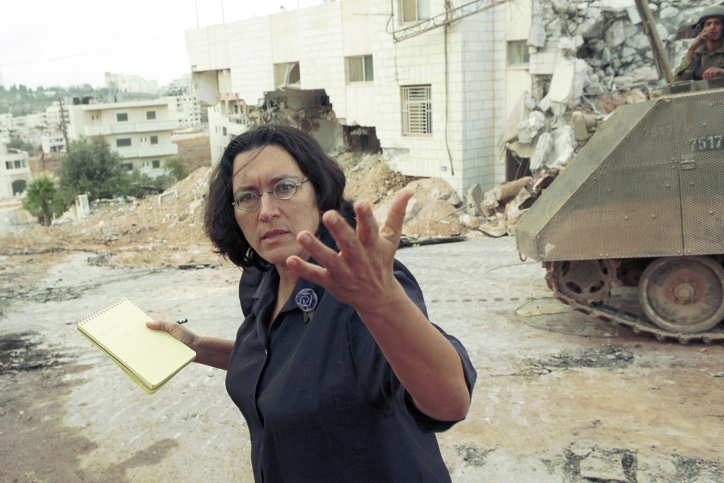
In early April of this year, the controversial Haaretz reporter Amira Hass, whose coverage of Palestinian violence over the last decade has often prompted accusations of bias, caused a major stir when she published a column called “The Internal Syntax of the Occupation.” Most provocative was her claim that “throwing stones is the hereditary right and duty of someone under a foreign power”—words that appeared only a few days after Adele Biton, a 3-year old Israeli girl, was critically injured when a Palestinian threw a rock at the car her mother was driving, causing it to slam into a commercial truck.
In a Sunday interview with journalist Kalman Libskind of the radio station Galei Yisrael, Haaretz publisher Amos Schocken set out to defend Hass’s article. Growing flustered, however, Schocken ended up saying that moving to a settlement was a form of deliberately endangering the welfare of one’s children, something that in another context would trigger the intervention of social services. As for Hass’s sympathy for rock-throwers, Schocken refused to distance himself. “Sometimes,” he concluded, “you have to fight violence with violence.”
The method Amos Schocken chose to defend Hass’s article, and his defense of editor-in-chief Aluf Benn’s decision to publish the piece in full, sheds some light on the recent changes at the once-venerable Israeli daily. In a series of interviews conducted with current and former Haaretz employees, some of whom held high-level positions at the paper and most of whom still hold it close to their hearts, a consensus emerged to the effect that the paper is undergoing a process of major change that has led to a dramatic reduction in staff, a precipitous decline in journalistic standards, and a willful radicalization of its politics in pursuit of Internet traffic.

Radicalizing. Veteran Haaretz reporter Amira Hass. Photo: Yossi Zamir/Flash90
As Israel’s longstanding newspaper of record, these developments have raised important questions about the future of print journalism, especially in a country where a free and dynamic press has always been at the center of Israel’s democratic discourse.
For decades, Israelis have associated Haaretz with journalistic quality—or, rather, they’ve associated journalistic quality with Haaretz. The paper was known for its scrupulous editorship and for articles, reviews and columns issued in a Hebrew so highly styled and written in such a lofty register that it bordered on the literary—something that comes as no surprise considering the paper’s pedigree. Salman Schocken, grandfather of Amos and patriarch of the family that controlled the paper for decades, transforming it from an official administrative paper of the British colonial authority into a cultural institution, was also the founder of one of the world’s most distinguished publishing houses—Schocken Books, which published Kafka, Hannah Arendt, Walter Benjamin and other literary luminaries of pre-war Germany.
The Amira Hass affair was a red flag not just for the Israeli public, but for many on the Haaretz staff as well.
Though it literally means “the land,” the Hebrew word haaretz is understood to refer to the nation, the country, and the State of Israel all wrapped up into one. And for three-quarters of a century, Haaretz in many ways was all that. It was Israel’s unrivalled national stage, and what played out in its news articles and opinion pages was Israeli public life itself. In this sense, it could be thought of as Israel’s New York Times—the difference being that the centrality of Haaretz to Israeli life was far greater than that of the Gray Lady in America, where a number of other stalwart dailies were able to successfully vie for readership and influence over the years. But although its circulation never approached that of the popular dailies Maariv and Yediot Aharonot, Haaretz had nothing that could be seriously spoken of as competition.
However, Haaretz has gone through excruciating times of late, much like the rest of Israel’s print-media industry. Recent months have seen major staff cuts, reports of a crisis between management and employees, the closure or downsizing of major supplements, and an oftentimes-inelegant shift in emphasis from print to digital.
But according to the employees interviewed for this article, all of whom refused to be identified out of fear of the impact on their careers in Israel’s small and insular media environment, the Amira Hass affair was a red flag not only for the Israeli public, but also for many on the Haaretz staff. As one former editor at the news desk put it:
Amira Hass’s article must be seen as the result of a conscious decision to radicalize the paper, to make it something shallow, sensationalist, and shocking, and to give it the image of a paper—really, a website—that is courageous and groundbreaking. At the end of the day, there is only one goal: To generate traffic. It doesn’t matter if the piece is good or bad, what matters is that it leads to website traffic.
Like most of the people we spoke with, the editor does not identify with the political Right in Israel. Yet he felt a need to add the following: “Amira Hass’s article fits Aluf Benn and Amos Schocken like a glove. She wrote shocking things. Any editor with a minimum of discretion would have said that it wasn’t suitable for publication. But here? The more provocative you are—to the Left, of course—the better the editorial staff thinks it is.”
Another former employee at the news desk described an incident that reflects what he sees as a significant deterioration in journalistic norms. On January 30, 2012, Haaretz’s diplomatic correspondent Barak Ravid published a
post on his blog “Diplomania,” titled “The Red Telephone Between Ross and Obama,” which revealed that Dennis Ross—who has served as Middle East envoy for several U.S. presidents—continued to be involved in government even after leaving his official post at the White House for a private think-tank. As Ravid reported:
Apparently, soon after Ross left his position as president Obama’s advisor on Iran and the Middle East, the White House took the unusual step of installing a secure telephone line in Ross’ office at the Washington Institute for Near East Studies. This is what many in Israel know from their military service as a ‘red telephone,’ on which it is possible to speak about classified information without fear of eavesdropping.
The news was hugely exciting for the American media, which began to investigate immediately. But the report quickly proved false. Jeffrey Goldberg, whom Haaretz often describes as a close confidant of President Obama, published a stinging post at the Atlantic titled “State Department: Dennis Ross Does Not Have a Bat Phone,” in which he derided Ravid’s “breathless” conspiratorial report. “If the President, or his national security adviser, wanted to talk to Dennis Ross about sensitive information (as they would, and should), why wouldn’t they just invite him over?” Goldberg asked, noting that “the Washington Institute’s offices are about five blocks from the White House.”
But what happened next, the former Haaretz news desk staffer told us, was even more bizarre. Rather than apologize for the error, Haaretz ran a follow-up
piece by Ravid, in which he assailed Dennis Ross and other critics, accusing them of being people who “love Israel but love Israelis somewhat less. Even if they don’t say it in public, they see Israelis as boorish Levantines. In their eyes, Israeli journalism is inferior to the Tablets of the Law that the journalistic establishment in the United States writes every day. Incidentally, in the circles surrounding Prime Minister Netanyahu there are those who hold the same view.”
But in publishing his attack, Ravid had inadvertently revealed that the decline in Haaretz’s journalistic standards has not been lost on many prominent people in Israel and the United States—in journalism and politics, and even among government. Worse still, instead of simply offering a sincere apology for his mistake and the embarrassment it caused his employers, Ravid doubled down, blaming the Americans for being arrogant enough to expose his failure.
“Haaretz is losing its standing and value,” the former news desk employee concluded. “When you look at the handling of the Ravid affair and the red telephone, you understand why.”
The employees who agreed to interview for this piece often disagreed to the precise causes for the decline of Haaretz’s journalistic standards. Yet they unanimously agreed that there has been a serious drop in quality at Haaretz over the past two years. The high number of layoffs and reductions at Haaretz are not a secret. Reportedly, Haaretz and its popular financial supplement, The Marker, will ultimately lay off 70-100 employees, or 20 percent of its workforce. In addition, employees who have not been laid off face deep salary cuts. Our sources spoke of a 15-35 percent cut in salaries, numbers that have yet to be confirmed and testify to the size of the financial sinkhole that has taken the floor out from under what was, until recently, Israel’s most respected paper. Published reports have also spoken of cuts of up to 20 percent in the budget for freelance writers, as well as cuts in the graphics and photography departments.
Haaretz’s new blend of sensationalism and radical politics has made the newspaper risk-prone and strikingly unable to self correct, even in the most clear cut of cases.
Haaretz has also cut or scaled back multiple departments of its print edition. In August 2012, the prestigious political supplement Hashavua (“The Week”) was discontinued, and employees were informed that its traditional content would now be folded into the weekend edition. Over the past year and a half, it was decided to merge the sports supplement into to the paper’s news section. Last month, the leisure and culture supplementAchbar Ha’ir (“The City Mouse”) was also discontinued. This followed the closure more than two years ago of the Schocken group’s largest local newspaper, Tel Aviv’s Ha’ir (“The City”).
Predictably, the severe cutbacks have shifted the work previously done by a well-staffed newsroom to a skeleton crew of remaining editors and reporters. The increased emphasis on the newspaper’s website, which with its faster news cycle requires a larger volume of stories, has only compounded the problem. “Today there are fewer and fewer writers and editors writing and editing more and more articles,” says one former writer. “You’re burning the candle at both ends, and the inevitable result is a serious drop in standards.”
Another employee spoke to us at length and described the drop in standards that resulted from the cuts. “There are cuts in manpower, in the amount of time editors and writers can dedicate to each item, and in the number of edits an article goes through before publication. You can feel the decline in quality. Management understood that the product would be inferior, despite the fact that they also knew that if you wanted people to pay for it, they’d need to offer a better product. The situation is bad any way you look at it. Things were getting worse for more than a year and a half before they [the management] responded. There was a drop in advertising income, and they failed to conduct prompt negotiations with employees. Because of this, they were forced to make sudden and brutal cuts… As a result, there were a lot of blunders at the paper and they’re getting a lot of criticism. People at the paper are exhausted. Right now, they’re basically going along to get along, in order to survive.”
Alongside the financial crisis and the wide-ranging cuts in staff and salaries, many Haaretz employees believe there is an additional reason for the paper’s decline in quality: A strategic decision by editor-in-chief Aluf Benn to refocus the elite paper to reach a much wider audience in order to maximize traffic, and the attendant advertizing income. “Aluf Benn’s managerial strategy,” says another source inside Haaretz, “is that the paper, and the website in particular, should publish stories that are as bold and provocative as possible. Everyone knows that publications like Yediot Aharonot or YNet [Yediot’s online edition] do this, but in the past Haaretz had different norms.” In the source’s view, the publication of the controversial Amira Hass piece was a deliberate attempt to draw traffic through sensational reporting.
To back up his claim, the source cites a letter Haaretz sent to advertisers as part of its marketing for the new version of its
Musaf Haaretz weekend supplement, which was
leaked to the media. The letter includes the following passage:
Life has started moving more quickly, we have no spare time, and if I’m going to read a newspaper over the weekend, give me something livelier, that I don’t need to work too hard for, something fun to read. So we made a decision. To create a new Saturday supplement. To make a drastic change. To take into account changing consumption habits, and to reinvent the wheel.
This may sound reasonable on its own; but when expressed in the form of increasingly alienating politics, one may begin to question the business logic behind it. Perhaps the most glaring example of the crisis of confidence surrounded the “apartheid poll” affair.
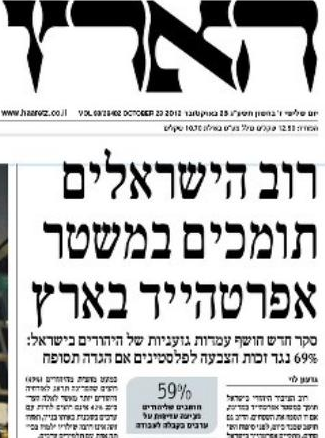
On October 23, 2012, an article by Haaretz’s notoriously scandal-prone columnist, Gideon Levy, was published as the main story on the front page of the newspaper with the outrage-provoking headline, “Most Israelis Support Apartheid Regime in Israel.” Yet a careful look at the survey on which the article was based revealed that neither the headline nor Levy’s analysis were supported in any way by the poll’s actual data. Following public criticism, Haaretz was forced to publish an apology five days later, as well as a correction, in small letters tucked away at the bottom of a page, that read:
Clarification: The wording of the main headline, “Most Israelis Support Apartheid Regime in Israel” (Haaretz, Oct. 23), did not precisely reflect the findings of the Dialog poll. The question to which a majority of respondents answered in the negative did not relate to any current state of affairs, but to a hypothetical future one: “If Israel were to annex the territories of Judea and Samaria [i.e., the West Bank], would you support granting 2.5 million Palestinians the right to vote in Knesset elections?”
In fact, Levy’s article almost entirely misrepresented the actual results of the poll,
according to independent analysts. According to numerous polls conducted over the past decade, most Israelis in fact support the creation of two states for two peoples and preserving the voting rights of Arab citizens of Israel.

“Most Israelis Support Apartheid,”
a headline the paper had to retract.
Photo: velvetunderground.co.il
“Regarding the article on the apartheid poll, which never existed, a normal editor would call the writer and suspend him until further notice,” says the news-desk editor cited earlier. “That’s how it works at a normal paper when a journalist almost deliberately does something very wrong. In some cases, the editor that gave Gideon Levy the assignment to write about a poll like this would also be sent home. It’s like leaving a wolf to guard the hens. And then, to make matters worse, after the hubbub around the issue, they tried to use it to show how Haaretz was a shining example of press freedom.”
In our interview, that editor described the apartheid poll affair as indicative of a broader problem. He cited additional examples of unprofessional decisions which, he believes, have harmed both Haaretz’s reputation and the high journalistic standards it set and adhered to in the past. Perhaps not surprisingly, Amira Hass stars in many of them. “Amira Hass receives priority for any nonsense she writes, including nonsense irrelevant to any self-respecting paper… She published a document that allegedly recorded a government discussion on how to prevent a famine in the territories in case of an Israeli siege. The document showed precisely the opposite of what was reported in the paper. Instead of reporting that Israel held a completely theoretical discussion of how to prevent a famine in Gaza, the paper portrayed it as if Israel were allocating such and such many grams and calories per person. It’s another example of how there is no responsible hand on the steering wheel.”
An even more pointed criticism of the editors’ objectivity came from another staffer familiar with the news desk. “There is almost no one who is not on the radical Left, or more precisely, who hasn’t accommodated themselves to it and suddenly become a Leftist. Except for Amos Harel and Haim Levinson, there are almost no journalists I would allow myself to call trustworthy. The rest are sycophants who suddenly joined the extreme Left. Israel Harel is the token Rightist in the opinion section, but if you look at the section in its entirety, it’s obviously getting systematically worse.” The same staff member also took issue with Benn’s decision to dedicate time to giving public lectures and writing opinion pieces for the paper.

Aluf Benn, editor-in-chief of Haaretz. Photo: Jewishfed.org
Of course, Haaretz is not the only newspaper in Israel facing hard times. While the Israeli public has grown increasingly unwilling to pay for print, the pace of innovation in digital media—and the willingness of the public to adopt new ways of consuming news—has progressed haltingly at best. While other papers have turned to populism and fluff to sell digital ads as a supplement to falling print revenues, Haaretz’s new blend of sensationalism and radical politics has made the newspaper risk prone and strikingly unable to self correct, even in the most clear cut of cases.
Though the newspaper has always taken a progressive political line, even its ideological detractors once recognized the benefit that a newspaper rooted in quality journalism and rigorous about its standards provided Israeli society. As Hanoch Marmari, who served as the paper’s editor-in-chief for close to 50 years after being appointed by Amos Schocken’s father, Gershom,
put it: “Today Haaretz is not in the playing field. Rather, it is morphed from a player to a spectator in the bleachers. When you are a distant observer you do not necessarily see the complicated dynamics of the game—and you definitely exert less influence.”
***
Haaretz’s editor-in-chief, Aluf Benn, offered the following response, reprinted here in full:
Haaretz always seeks to reach new audiences, whether in print or through digital channels. According to statistics from the Internet Rating Commission, the Haaretz website enjoyed a substantial growth in traffic in 2012. This year, at the beginning of March, we instituted paid subscriptions for our digital journalism. Thousands of readers have already signed up. These accomplishments are the result of efforts made by our staff to learn the language of digital journalism, as well as a reorganization of our news desk and our Hebrew and English websites. Not only have our professional standards not been harmed, but our reporters must be even more careful today because of the constraints of digital media, which updates continuously. There is no doubt that this is a difficult change for some journalists, but it is positive for any media outlet that wants to flourish in the digital age.
Amira Hass was and is one of the best journalists I have ever met in my 27-year career. I am happy to discover that, to many of her former colleagues, including those with extensive knowledge of the issues she covers, she has not lost her relevance and her writing continues to arouse a great deal of interest and bring us new readers.
Sadly, we parted from around a hundred of our friends this year. They resigned or were laid off because of cuts forced upon us by the precipitous drop in our advertising budget. In certain cases, employees stayed on staff at a reduced salary. Not only have these cuts not hurt the quality of the paper, but the opposite is the case: They have forced us to develop and renew ourselves, first and foremost through the publication of the new “Musaf”—the best journalistic publication in Israel, as well as the redesign of the daily and Friday “Galleria” supplement, the publication of “Haaretz Ha’Shavua,” whose contents were previously split between two supplements, and an upgrading of our digital content.
At Haaretz, we sometimes make mistakes, and when we do, we correct them. The headline given the apartheid poll article was a mistake, and when the issue was clarified we published a correction. In the article on Dennis Ross, there was a mistake in a marginal and unimportant detail. Unfortunately, those who complained about the mistake chose to insult and slander a Haaretz writer, and I was not and am not prepared to accept rhetorical violence against our reporters as a basis for discussion. In spite of this, we published a front-page interview with Ross conducted by Natasha Mozgovia (our former Washington correspondent), in which it was made clear that there is no secure telephone in his office. The post subsequently published by Barak Ravid was excellent and put the issue in its correct and appropriate context.
I have not stopped writing political analyses since I became the editor-in-chief of Haaretz, and there is and does not have to be a conflict between the two. Writing requires me to “take the pulse” of things, and this serves as a personal example to other writers. I sometimes give paid lectures, but this has caused no damage to my work on the staff, and I have not prevented other journalists from writing books, lecturing, or teaching alongside their work as writers and editors.
* * *
Editor’s Note: A version of this article
appeared in Hebrew at Mida, a publication of El Haprat, a nonprofit organization.


 Residentes judeus da Judeia e Samaria ficaram chocados ao verem uma bandeira nazista tremulando sobre uma mesquita na vila palestina de Beit Omar perto de Hebrom na segunda-feira. A bandeira estava visível para milhares de cidadãos israelenses que passavam pela mesquita a caminho de Hebrom para trabalhar.